

AI Environments: Cloud vs. on-prem and the shift toward bringing AI back in-house
AI is rapidly reshaping everything, and the decisions around IT infrastructure have never been more important. Gone are the days of simple “cloud-only” mandates; enterprises are now evolving within a rapidly changing tech stack and trying to identify the right environment for their AI workloads.

What motivates companies to choose between public and private cloud approaches for AI?
It’s a complex decision with many considerations.
Public cloud strengths: speed, scale, and access
For most organizations, public AI clouds offer significant power and scalability. Teams can quickly provision and de-provision infrastructure for models, training, and experimentation, accessing large amounts of CPUs and GPUs on demand without heavy upfront investments. This OpEx model, combined with the provider’s AI expertise, lowers the barrier to entry and enables faster, more controlled innovation. Public AI cloud providers also offer immediate access to cutting-edge specialized hardware like GPUs and TPUs alongside an unmatched ecosystem of pre-built AI models and managed services.
Why enterprises turn to private and on-prem AI
However, many enterprises are embracing private or on-premises AI as their initiatives mature. The primary driver is enhanced control and data security. Owning your data and the intelligence trained from it is similar to protecting the investment in a highly trained employee. Dedicated environments isolate sensitive workloads, reducing breach risk and preventing unauthorized access, which is critical for proprietary models and sensitive datasets.
Performance, predictability, and long-term cost control
Performance consistency and ultra-low latency are also major advantages. Dedicated resources reduce contention, ensuring predictable, responsive performance for real-time AI applications such as multimodal processing, edge computing, fraud detection, or autonomous robotics. While CapEx may be higher initially, private AI often delivers better long-term cost efficiency for predictable workloads. It also minimizes “spending sprawl,” reduces ecosystem lock-in, and preserves full control over the AI software stack.
Are companies moving AI workloads out of the public cloud?
Absolutely. AI is the primary driver of this shift, and the trend is accelerating.
Legal pressure, resource constraints, and control
With lawsuits over training data and fair-use concerns emerging daily, organizations are reevaluating where their data lives and who benefits. Competition for resource availability, energy access, and control is also pushing enterprises to rethink cloud dependency.
When public cloud costs stop making sense
AI workloads consume significant compute resources. As AI moves from experimentation to production, public cloud costs often climb unpredictably. What begins as a flexible OpEx strategy can quickly become financially unsustainable for continuous, heavy-duty AI operations, especially when teams cannot yet accurately quantify utilization or productivity gains.
Data sensitivity and competitive risk
Even more critical is the sensitivity and volume of the data AI systems process. Ensuring privacy and security for production AI applications is a major driver for bringing workloads back in-house. AI can transform nearly any data into actionable intelligence, expanding attack surfaces and stressing existing security systems. And lingering concerns remain: does your cloud provider gain insight or training advantages from your data? That information is your competitive edge.
Ecosystem lock-in and loss of flexibility
Once a company’s data accumulates within a public cloud, the gravitational pull of nearby services makes migration difficult and costly. High egress fees compound the problem. Meanwhile, the AI landscape is exploding with new tools, models, and providers. Lock-in can limit access to external innovation and ultimately erode competitive advantage.
Latency, compliance, and real-time requirements
Performance degradation (e.g. latency, shared-resource bottlenecks) also pushes AI workloads back to controlled private environments, especially for real-time use cases. And industries bound by regulatory, compliance, or sovereignty requirements often have no choice but to keep sensitive data in-country or on-prem.
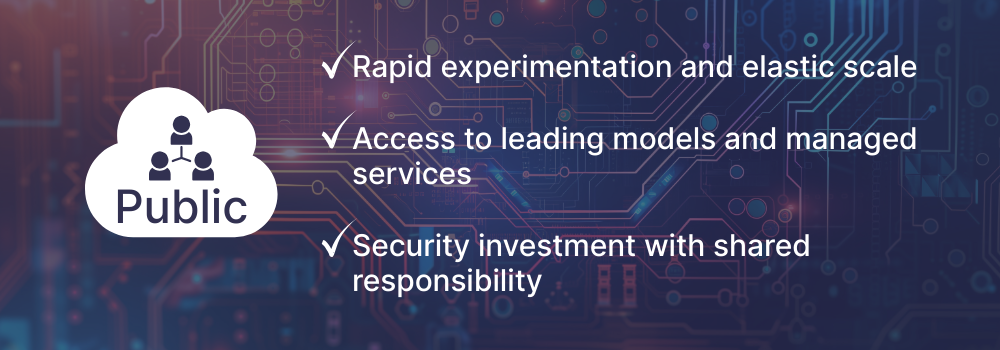
What are the key advantages of running AI workloads in the public cloud?
Despite the shift toward bringing some AI back in-house, public AI cloud providers remain incredibly valuable for many use cases.
Rapid experimentation and elastic scale
Their primary strengths are innovation, agility, and scalability. Organizations can rapidly spin up infrastructure for model training, experimentation, and testing, reducing time to market. The ability to scale into thousands of CPUs or GPUs on demand is vital for unpredictable, bursty AI workloads—particularly during training.
Access to leading models and managed services
Cloud providers also offer a rich ecosystem of pre-built tools, APIs, and fully managed services from leaders like OpenAI, Google, Anthropic, and AWS. These reduce the need for deep in-house AI expertise and make advanced general-intelligence models accessible and operational across the enterprise.
Security investment with shared responsibility
Public cloud platforms also invest heavily in secure infrastructure, offering capabilities like Virtual Private Clouds and fine-grained access controls. But the shared responsibility model still applies: the provider secures the cloud, while customers must secure their data and configurations inside the cloud.
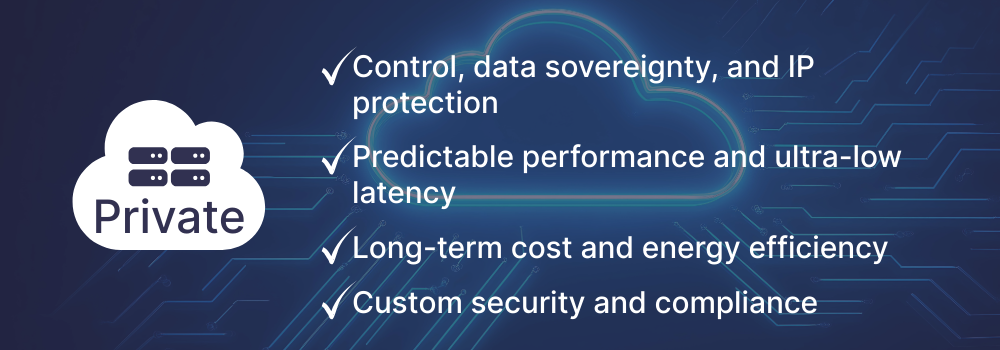
What are the advantages of on-premises environments?
From our perspective, on-premises and private cloud environments offer distinct advantages for business-specific, sensitive, and performance-critical AI workloads, especially where cost, energy, and security objectives matter.
Control, data sovereignty, and IP protection
These environments deliver the highest level of organizational oversight, ensuring sensitive information stays where it belongs. This is crucial under regulations such as GDPR or HIPAA. It also protects intellectual property by keeping proprietary datasets and applications on-site.
Predictable performance and ultra-low latency
Dedicated compute resources reduce variability and network delays, supporting faster AI training and inference. Local processing is essential for real-time systems where milliseconds matter, such as image detection, robotics, and autonomous workflows. Local NVIDIA compute (A100s, Jetsons) or Apple silicon (M-series) offers exceptional performance and energy efficiency, with Apple silicon’s Unified Memory Architecture and Neural Engine providing particularly strong edge-AI capabilities.
Long-term cost and energy efficiency
Cost predictability is another major advantage. While upfront CapEx is required, long-term costs are often lower and more stable, avoiding public cloud usage spikes, egress fees, and volatile storage costs. Apple silicon is highly energy-efficient and can significantly reduce ongoing operational expenses.
Custom security and compliance
Private environments allow for highly customizable security and compliance. Organizations can design stringent protections like air-gapped systems, immutable snapshots, and rapid-recovery architectures. For industries where oversight of the entire data lifecycle is mandatory, on-prem ensures everything stays under direct control.
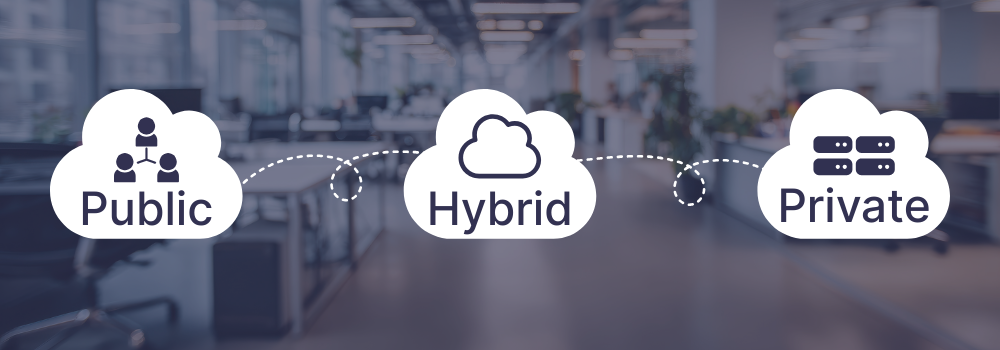
Where should businesses host their AI?
Public AI cloud providers offer unmatched agility for training, experimentation, and model development, along with broad tool ecosystems and near-limitless scalability. But private and on-prem solutions, especially those leveraging dedicated, efficient compute like Apple silicon, deliver the control, performance, predictability, and long-term cost efficiency needed to operationalize AI at scale, particularly for sensitive data and mission-critical workloads.
For most enterprises, the future is hybrid: choosing the right environment for each stage of the AI workflow and combining the best of both worlds to maximize innovation, control, and value.