



Dev Tools
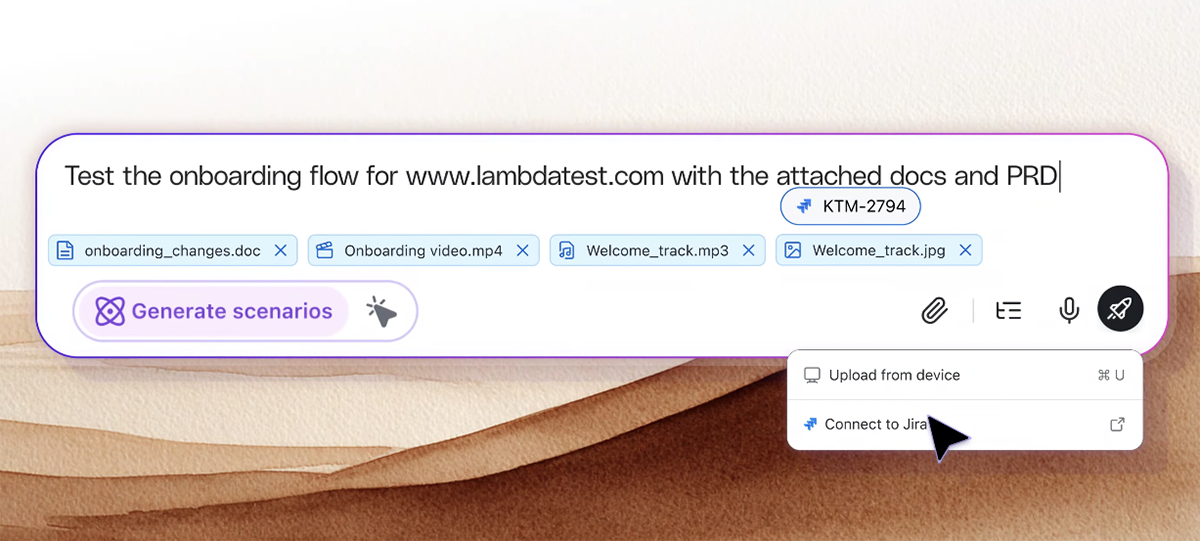
TestMu AI (formerly LambdaTest) runs its testing platform and local AI inference on MacStadium Mac infrastructure. A MacStadium customer since 2017, the company has grown its Apple fleet sixfold and is now working toward running its entire platform on Mac by 2030 to gain the performance and efficiency benefits of Apple silicon at scale.
About TestMu AI
TestMu AI is a full-stack agentic AI quality engineering platform that empowers teams to test intelligently and ship faster. Engineered for scale, it offers end-to-end AI agents to plan, author, execute, and analyze software quality. AI-native by design, the platform enables testing of web, mobile, and enterprise applications at any scale across real devices, real browsers, and custom real-world environments.
TestMu AI is transforming test automation by helping teams plan, create, and evolve end-to-end software testing, all using natural language. KaneAI is the world’s first GenAI-native testing agent for autonomous, agentic QA, enabling engineers to write and execute automated tests using plain English instead of traditional scripting.
The challenge
TestMu AI’s customers test web and mobile apps across thousands of browser, device, and operating system combinations. macOS is a required part of that mix, and it must be available at scale, on demand.
To power its testing platform, TestMu AI runs a hybrid environment across on-prem servers, its own colocation data center, and public cloud resources. For Linux and Windows, this was no problem, but running a similar environment for Apple proved difficult. Running Macs with a hyperscale cloud provider was too costly at the required scale, so the company turned to MacStadium for Apple infrastructure in addition to its own on-prem and colocated Macs.
As TestMu AI began building AI directly into its products, including its GenAI testing agent, KaneAI, it needed additional high-performance computing resources tailored for AI-driven applications.
The solution
Mac infrastructure that grows with the business
Having relied upon MacStadium’s Apple infrastructure for its testing platform since 2017, TestMu AI knew that MacStadium could ensure seamless deployment, scaling, and execution of its AI-native solutions without compromising speed, security, or reliability. In 2019, the company ran roughly 300 Macs with MacStadium. Today, it runs 1,800 machines, primarily Apple silicon M1 and M2 Mac minis.
MacStadium’s enterprise-grade cloud infrastructure, designed for business-critical applications, ensures data protection. MacStadium handles the infrastructure layer, including security and firewalls, so the TestMu AI team can focus on its platform. If issues arise, MacStadium’s support team is available to respond quickly.
Turning spare test capacity into AI capacity
Customer testing demand fluctuates, so at any given time, some of TestMu AI’s Mac capacity is unused. Rather than leave that capacity idle, the team puts the available Macs to work running AI inference. “All 1,800 servers are not always used by our customers,” explains Akash Agrawal, TestMu AI’s vice president of DevOps and DevSecOps. “We wrote our own code so that if a Mac is free, we can use it to run inference for our AI workloads.”
Today, that capacity supports several AI workloads. TestMu AI runs models locally through Hugging Face, selecting models based on the use case, including DeepSeek and, increasingly, its own in-house models. MacStadium infrastructure also supports the Mac workloads behind KaneAI, which orchestrates test cases for QA teams and developers. The company has even dedicated MacStadium servers to running OpenClaw as a private AI assistant for its developers.
TestMu AI found Apple silicon particularly well suited to these workloads, citing faster, more streamlined inference along with strong memory and network performance.
One platform instead of many
TestMu AI is consolidating onto Apple infrastructure company-wide. Rather than building and maintaining software and binaries for multiple operating systems, the team wants one ecosystem. Its real device testing, which runs in TestMu AI’s own colocation facility, also runs on Mac.
Why MacStadium
After nearly a decade, reliability and speed continue to be central to TestMu AI’s relationship with MacStadium. “MacStadium is the only partner where I have never faced an issue since we started working together. No downtime, no contract issues, nothing,” says Agrawal.
That consistency matters as TestMu AI continues to expand its Mac footprint. When the team needs more capacity, MacStadium can typically deliver new Macs within about two weeks. According to Agrawal, acquiring 300 bare-metal Macs from a public cloud provider can take four to five weeks. MacStadium also gives the team a straightforward path to newer generations of Apple silicon as they become available.
For TestMu AI, those advantages have turned what began as an infrastructure relationship into a long-term partnership—one the company expects to continue as it moves more of its infrastructure to Mac.
What’s next
TestMu AI’s partnership with MacStadium positions it at the forefront of AI transformation. By leveraging Apple’s cutting-edge cloud computing resources, TestMu AI is ensuring scalability, security, and efficiency in AI-powered software testing. TestMu AI is upgrading its MacStadium fleet from M1 and M2 minis to M6, and every new Mac it orders is now an M6.
The team has already seen what the new hardware can do. When its first 50 M6 machines arrived at the TestMu AI office for its real device lab, the team benchmarked them on real workloads the same day. Peak performance was at least 30% faster, which means a test run that used to take an hour now finishes in 40 to 45 minutes.
Longer term, the goal is bigger. Apple silicon, known for its superior performance and efficiency in AI workloads, provides the ideal environment for the company’s advanced AI testing capabilities. TestMu AI runs roughly 88,000 servers across VMs, on-prem hosts, and cloud infrastructure, and plans to move all of them to Mac by the end of the decade.
“We have been moving our workloads from Linux to Mac,” said Agrawal. “Apple offers more flexibility, more scalability, and the performance is much better. We will be the company that is completely on Mac by 2030.”